Introduction
Robo-advisor vs DIY investing is one of the most important decisions beginners face when starting their investment journey—because it determines how much control, time, and responsibility you’ll have over your money. This choice isn’t just about tools or fees; it’s about how you behave when markets move and decisions feel uncomfortable.
Many beginner investors feel caught between automation and independence. Robo-advisors offer simplicity, structure, and protection from emotional mistakes, while DIY investing provides flexibility, learning, and full control—but also increases the risk of poor timing and inconsistent behavior. This guide breaks down robo-advisor vs DIY investing in practical, real-world terms, focusing on behavioral trade-offs, time commitment, and confidence so you can choose the approach that fits your temperament—not marketing promises.
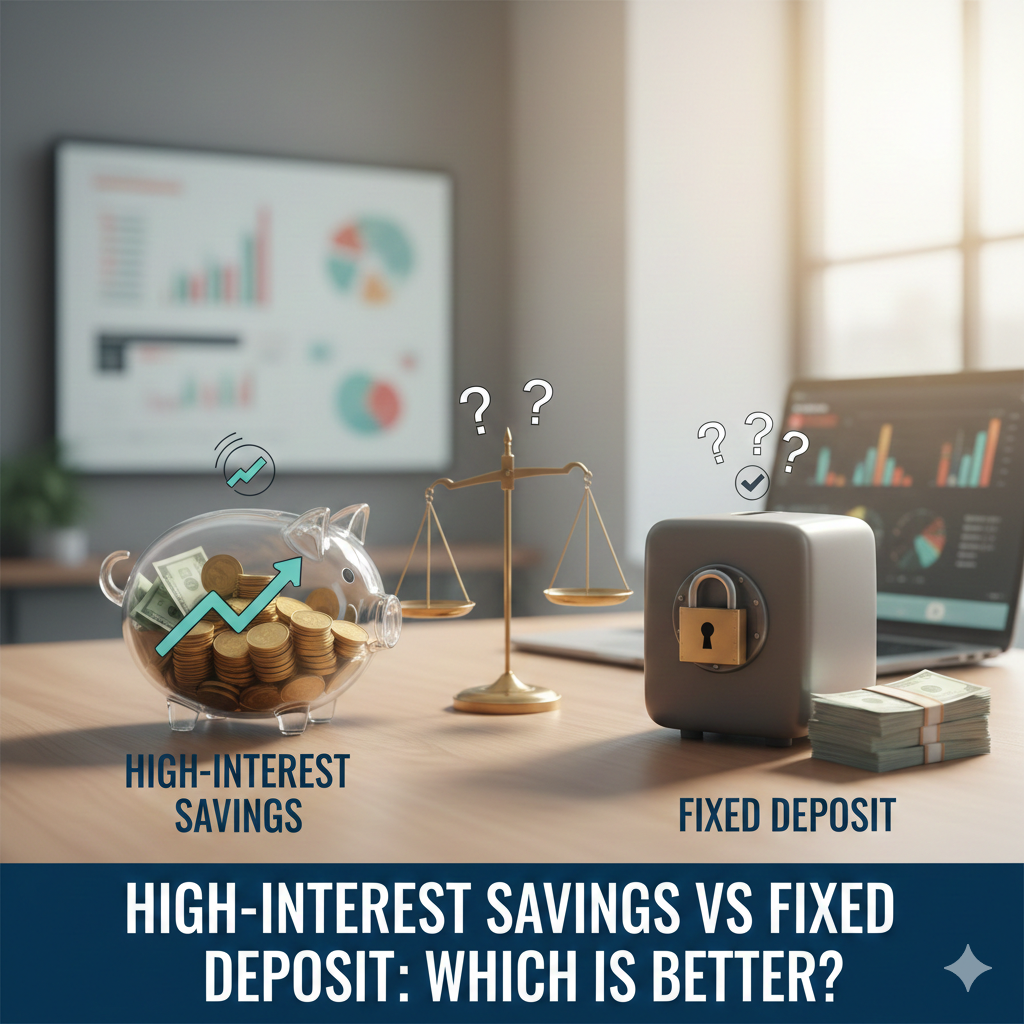
What a high-interest savings account really offers
A high-interest savings account is designed for access with restraint.
Key traits:
- Easy deposits and withdrawals
- Variable interest rates
- Ideal for emergencies and short-term goals
It keeps money reachable while earning more than basic checking.
[Expert Warning] Beginners often overlook rate variability—savings rates can change over time.
What a fixed deposit (FD) actually does
An FD locks your money for a fixed term (months or years) at a fixed rate.
Key traits:
- Predictable returns
- Limited or penalized early withdrawals
- Best for money you won’t need soon
FDs reward certainty and patience.
[Pro-Tip] From real usage, FDs work best when the money already has a “do not touch” purpose.
The differences that matter most for beginners
Access to money
- Savings: Anytime access
- FD: Locked until maturity (or penalties apply)
Interest certainty
- Savings: Variable
- FD: Fixed and predictable
Behavioral impact
- Savings: Encourages flexibility
- FD: Enforces discipline by design
Common beginner mistakes (and fixes)
Mistake: Locking emergency funds in an FD
Fix: Keep emergencies in savings—FDs are for surplus only.
Mistake: Chasing the highest rate blindly
Fix: Match the product to the time horizon.
Mistake: Putting all savings in one place
Fix: Split by purpose (liquid vs locked).
Information Gain: Time horizon decides the winner
Most SERP pages compare rates. What they miss is time alignment.
- Short term (0–12 months): Savings wins
- Medium term (1–3 years): Mix can work
- Longer term (3+ years): FD may fit
Choosing the wrong product for the time horizon creates frustration—even if the rate is higher.
Real-world scenario: a balanced beginner setup
In practical situations, beginners do best with:
- Savings account for emergencies and near-term needs
- One small FD for a defined goal (e.g., tuition, planned purchase)
This balances access and discipline.
[Money-Saving Recommendation] Start with a modest FD amount first; scale only after you’re confident you won’t need the cash.
Table: High-interest savings vs FD at a glance
| Feature | High-Interest Savings | Fixed Deposit (FD) |
| Access | Anytime | Locked |
| Interest rate | Variable | Fixed |
| Early withdrawal | Free | Penalties |
| Best for | Emergencies, short-term | Planned goals |
| Beginner suitability | Very High | Medium |
When savings is the better choice
Choose savings if:
- Income or expenses fluctuate
- You’re building an emergency fund
- You want flexibility without stress
Savings reduces regret when life changes.
When an FD makes more sense
Choose an FD if:
- The money has a clear, future purpose
- You won’t need access before maturity
- Predictability matters more than flexibility
FDs shine when goals are specific.
FAQs
Is an FD safer than a savings account?
Both are generally safe; access and penalties differ.
Can I break an FD early?
Yes, but usually with penalties.
Do savings accounts always earn less than FDs?
Not always—rates change over time.
Should beginners start with FDs?
Only after emergency funds are secure.
Can I use both together?
Yes—many beginners should.
Which helps saving discipline more?
FDs enforce discipline; savings rely on habit.
Conclusion
High-interest savings vs FD isn’t a competition—it’s a coordination problem. Savings protects flexibility; FDs protect commitment. When you match the product to the time horizon, both work together to reduce stress and build progress.
Internal link
https://financehired.com/index.php/2026/01/08/savings-vs-checking-account/
External link
CD vs. High-Yield Savings Account: Which Should I Choose? – NerdWallet